






Custom made item. Please expect a lead time of about 6-10 weeks. Plan accordingly and let us know if any issues.

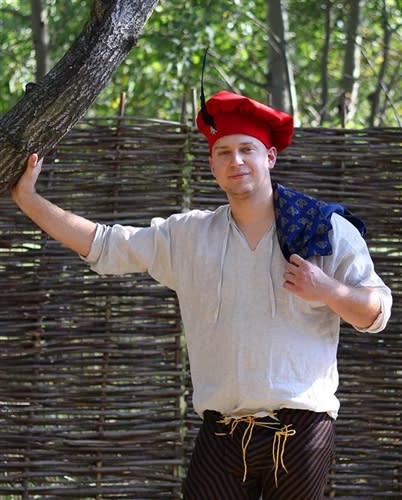
Medieval shirts made of linen are an essential part of a former underwear for men. Together with braies it makes a basic set for reenactors who start completing their historical costumes.
Our medieval men's shirt looks best in white and natural colors, but of course other colors are also available. If you would like us to make your medieval shirt from a different material, for example silk or cotton, please contact us before placing your order.
The presented medieval men's shirt consists of rectangles. It has a cut and strings under the neck. In the Middle Ages, depending on region and period, shirts could have had various finishing, differing in length, cuff, or collar. That's why on your request we can prepare a unique medieval shirt. Send us a picture of your dreamed-of medieval shirt, and we will prepare it for you.
 |  |
| This shirt has a V-neck and is tied with two strings. | Made of the highest quality natural linen. This material is very breathable, anti-allergic and, above all, has hygroscopic properties. Perfect for clothes that touch the skin, e.g. underwear or pants. |
↪ Economic standard is sewed entirely by machine.
↪ High standard means sewing by hand.
↪ Medium standard is a mix of two: visible seams are made by hand, while the rest by machine.
The history of shirt is very long. The archetypes of medieval men’s shirt are probably tunics from Central Asia. Tunic moved from there to Sumerians, Babylonians and Egyptians. Later, it gave rise to Greek chiton and Roman tunic. Camisia, a tunic from Gaul worn also by Teuton tribes, had a "T" letter shape, derived from the Middle East. In all Roman languages the word "shirt" comes precisely from the word "camisia".
The underwear for men and women started to differ in the 12th century. Medieval shirts for men, like the rest of clothing for men, became shorter, and female shirt was the basis of a chemise. In medieval Central Europe linen fabric was whitened by exposing it to the sunlight and pouring water, to speed up the process. An example of a medieval shirt can be found in Tacoinum Sanitatis.
The task of medieval underwear was to isolate the body from the outer woollen clothes - it was the only element of garments that was regularly washed. Usually it was made of linen, for wealthier users of silk, and in the late part of the Middle Ages of cotton. It is a basic and inseparable part of medieval clothing. Medieval men's linen consists of a shirt, braies and sometimes an underwear belt, and medieval women's linen consists of a long shirt.
